Process versus Outcome?
Evaluating how we reach our goals.

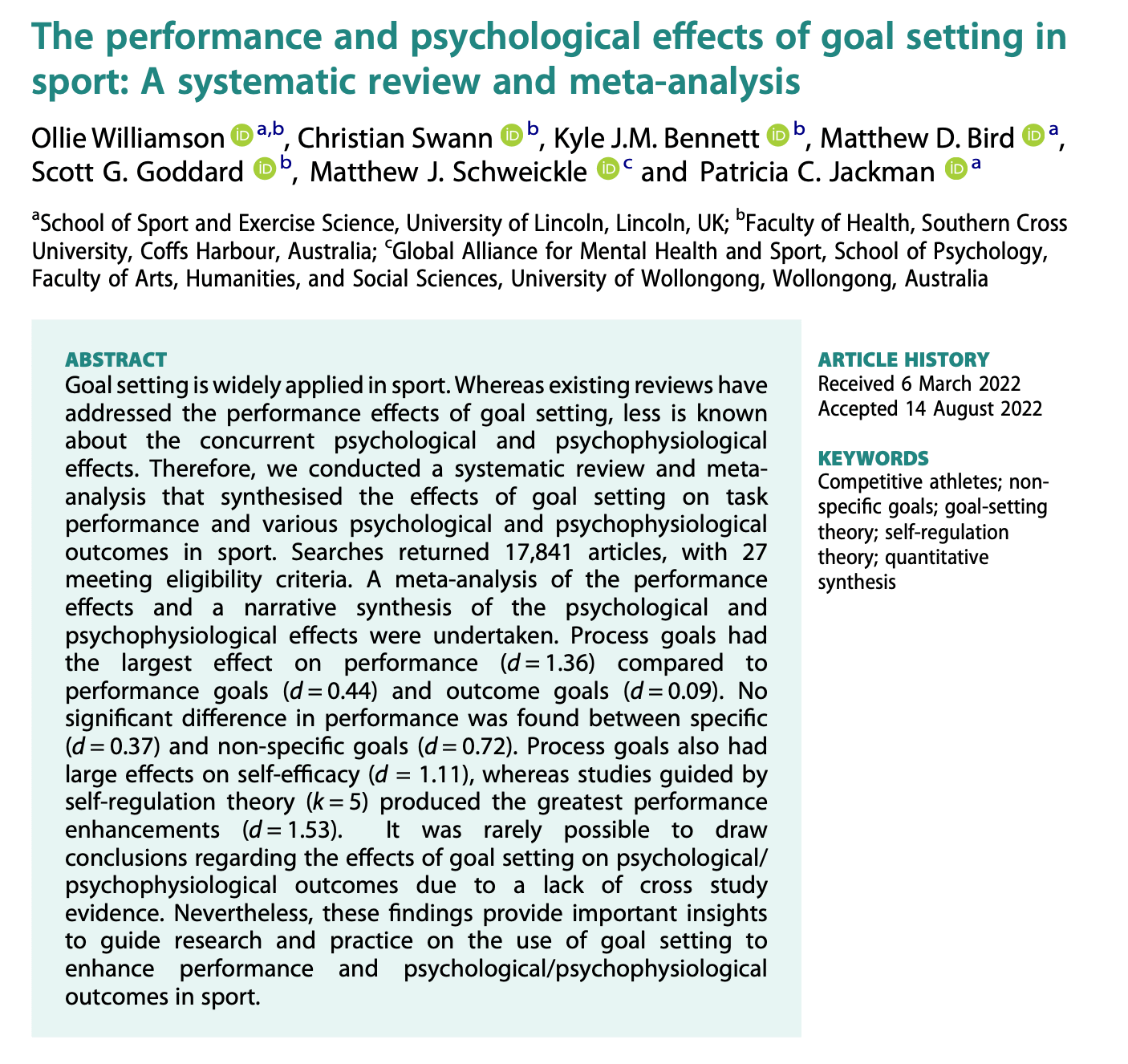
I stumbled across this paper the other day and it caught my attention because the abstract hinted at a comparison between ‘process’ and various forms of ‘result’ oriented goals (available in full here). In fact, systematic reviews and meta-analyses like this can be a bit of struggle to read, there is a lot going on in terms of methodology and how the data is analysed. So having waded through it I followed some of the paper trail of references to previous studies that help outline the research area and better define each goal class1.
Results orientated goals - outcome goals and performance goals as they are termed - tend to identify key targets for achievement. For outcome goals this may be winning a game or a competition - specific, well-defined. Performance goals are also target oriented but are more likely to be achieving a certain score, scoring first, converting a certain percent of corners.
Process goals can be a little more nebulous and, in the academic literature, more commonly associated with an individuals focus on particular aspects of technique. This may be to check the grip, to think about the correct foot patterns for a drag flick, to regularly tell oneself to pre-scan, or, as one paper puts it, ‘watch the ball in striking games’ which of course kind of defines hockey. But it can also build into tactical processes that require individual players to monitor their playing behaviour in order to do the right thing at the right time: recover through the middle after a high press has been broken, step forwards in a defensive zone when pressure is being applied in front of you, find a space between lines to receive an aerial, walk the ball out of your own circle so as not to immediately return an ill directed clearance to the opposition. Importantly, process goals are more interested in development and not on a specific target - winning this game, topping that league are not the language of process goals, but ultimately may well be the outcome.
It’s of interest I think because of the comparison one can make between the psychological and philosophical ideas of how to improve a team (or player though the two are inextricably linked) via goal setting. Where do want to be, how do we get there? This has been a topic on The Hockey Site before when Jamilon Mülders gave an excellent talk on Results versus Process, his emphasis, with which I wholly agree, being that viewing coaching as a process rather than defining and chasing simplistic results is the way to go. And this is largely supported in the paper above and the others I’ve linked to in the footnote.
Taking a more process oriented approach is very attractive if one can expect to be with a team over a few seasons (the coaching carousel in Dutch hockey notwithstanding) particularly because of the way it can positively influences players’ self efficacy - the player’s confidence in their ability to perform the desired technical or tactical tasks. Such increasing confidence, though somewhat opaque in the context of clear ‘win the game’ outcome goals, leads to more holistic team development and performance consistency2.
‘Trust the process’ might be a somewhat hackneyed maxim but it is nevertheless an important one and it is nice to see some academic research supporting its role over and above more specific and one dimensional outcome goals.
And, in my experience, is particularly important for junior teams where outcome goals, which are easy to define and so can be used judge the ‘progress’ of the team, often appears to be the driving principle.